


A prestigious law firm can appear stable from the outside.
It may have a famous name, elite clients, highly compensated partners, top-of-market associate salaries, and offices in major financial centers.
But inside the firm, the situation can change quickly.
A major partner leaves.
Several colleagues follow.
Clients begin asking questions.
Associates wonder whether their work will remain.
Other firms start recruiting.
And suddenly, lawyers who believed they were building long-term careers at one of the most respected firms in the world are forced to reconsider their futures.

This is one of the biggest risks in modern BigLaw: your career may depend more on the partners who control your work than on the prestige of the firm employing you.
Recent developments at Weil, Gotshal & Manges have brought this issue into sharper focus.
According to October 21, 2026 reporting from Financial News, Weil has explored potential merger options following nearly 40 partner departures during 2026. The reported departures include prominent transactional partners, while the firm has also made efforts to strengthen its leadership and recruit talent.
No merger has been confirmed, and discussions do not establish that the firm is financially distressed.
Nevertheless, the situation highlights an important issue for associates throughout the legal profession.
What happens to your career when the partners responsible for your work, training, and advancement decide to leave?
The answer can determine whether you continue progressing, lose valuable opportunities, or need to make a carefully planned lateral move.
Law Firm Prestige Does Not Guarantee Career Stability
One of the biggest assumptions young attorneys make is that prestigious firms are automatically stable places to build careers.
Prestige can offer significant advantages.
It may provide:
Access to sophisticated clients
Complex legal matters
Strong compensation
Extensive training resources
Valuable professional relationships
National and international recognition
Better visibility in the lateral market
But prestige is not the same as security.
Even highly profitable firms can experience partner departures, practice group restructuring, compensation disputes, leadership changes, and client movement.
A law firm may be financially successful overall while individual practice groups face uncertainty.
For associates, this distinction matters.
You do not build your career inside a law firm’s rankings. You build it through the matters, partners, clients, and experience available to you.
Attorneys should therefore evaluate more than a firm’s brand name. BCG Attorney Search’s report on law firm stability, hiring consistency, and warning signs of employer risk offers a broader framework for evaluating whether a legal employer can provide sustainable opportunities.
1. When a Star Partner Leaves, the Work May Follow
One of the most important things associates need to understand is how law firms generate revenue.
A large portion of sophisticated legal work may originate from relationships maintained by individual partners.
Some client relationships are deeply institutional.
Others are closely connected to a particular lawyer.
When a star partner moves to another firm, some clients may consider moving their matters as well, subject to their own choices, conflicts, applicable rules, and existing engagements.
That can have immediate consequences for associates.
Consider an associate who works almost exclusively for one major corporate partner.
That partner controls several significant client relationships and generates much of the associate’s work.
The partner leaves.
The associate stays.
Several things could happen:
Existing matters remain with the original firm.
New matters begin going to the departing partner’s new firm.
The associate loses access to important transactions.
Other partners absorb some of the remaining work.
The associate must develop new internal relationships.
The practice group reorganizes.
The associate receives fewer assignments.
The associate may have excellent credentials and strong performance reviews.
But neither guarantees continued access to billable work.
This is why attorneys should understand how client relationships, origination credit, and practice development affect law firm economics.
The issue is especially important in firms where a small number of rainmakers control substantial revenue.
2. Associates Can Lose More Than Billable Hours
When an influential partner leaves, the immediate concern is often workload.
Will there be enough billable hours?
Will the client matters remain?
Will the practice group continue growing?
But the consequences can extend much further.
An associate may lose:
A mentor who provides meaningful feedback
A partner who advocates for promotion
Access to important clients
Opportunities to manage transactions or litigation
Exposure to sophisticated legal strategy
A potential future business-development sponsor
Support during compensation and performance reviews
Someone willing to invest in their long-term development
These losses can be difficult to replace.
A partner who consistently gives an associate good assignments may play a major role in the associate’s professional growth.
The partner may also understand the associate’s strengths, introduce them to clients, and help them develop a practice identity.
When that relationship disappears, the associate may need to rebuild professional capital inside the firm.
That takes time.
As discussed in The New Prestige Question: Which Law Firms Actually Develop Associates?, a law firm’s reputation matters, but the training, trust, and responsibility an associate receives may have greater long-term career consequences.
3. Not Every Partner Departure Is a Warning Sign
Associates should avoid assuming that every lateral partner move signals serious trouble.
Partner movement is a normal part of the legal market.
Partners leave for many reasons:
Better compensation
Greater practice support
Geographic expansion
Client conflicts
Leadership opportunities
Differences over firm strategy
Access to complementary practices
A different compensation structure
Succession planning
Personal career priorities
A healthy law firm may lose a prominent partner without experiencing broader instability.
It may also recruit new partners, redistribute work, strengthen existing practices, or develop new client relationships.
The concern becomes greater when several warning signs appear together.
These may include repeated departures from one practice group, declining work assignments, unsuccessful efforts to replace lost business, significant leadership turnover, and unclear communication about the group’s future.
One partner leaving is an event. A sustained loss of revenue-generating partners without replacement may become a structural problem.
Associates need to distinguish between the two.
4. The Most Vulnerable Associates Depend on One Partner
Some associates build their entire professional lives around one influential partner.
That relationship can be extremely valuable.
The partner may provide excellent training, significant responsibility, and strong advocacy.
But it can also create dependence.
If the relationship ends unexpectedly, the associate may have limited internal alternatives.
This is why associates should build relationships across the firm whenever possible.
That includes:
Working with several partners
Developing relationships across related practice groups
Becoming known for specific skills
Building credibility with senior associates and counsel
Participating in matters involving multiple clients
Understanding the firm’s broader business
Maintaining strong professional relationships outside one team
The goal is not to avoid loyalty.
It is to avoid having your entire career depend on one person.
The strongest associates have sponsors. The most resilient associates also have options.
That distinction becomes especially important during periods of partner turnover.
5. Should Associates Follow a Departing Partner?
This may be the most difficult decision an associate faces.
A partner announces a move.
The partner has been an important mentor.
The associate knows the partner’s clients, working style, and expectations.
The partner suggests that the associate should consider joining the new firm.
Should the associate follow?
Sometimes the answer is yes.
Following a partner can offer:
Continuity of work
An established professional relationship
Familiar client matters
Strong advocacy from a trusted mentor
Greater responsibility
A better practice platform
Potential compensation improvement
Opportunities to help build a growing team
But following a partner is not automatically the right decision.
The new firm may have different expectations, compensation arrangements, billing requirements, management structures, or partnership opportunities.
The partner may also encounter difficulties integrating into the new platform.
Before moving, associates should ask:
Will the partner have enough work for me?
What clients and matters are realistically expected to continue?
Does the new firm need someone at my seniority level?
Who will evaluate my performance?
Will my class year and compensation be preserved?
Will I have opportunities to work with other partners?
What happens if the partner’s expected business does not materialize?
Does the new firm strengthen my long-term marketability?
A respected partner’s invitation can be a valuable opportunity.
But it is not a substitute for due diligence.
For additional guidance, BCG Attorney Search explains how attorneys can make a successful lateral move and adapt to a new law firm’s culture, expectations, and internal relationships.
6. Staying Can Be the Better Career Decision
When several partners leave a firm, remaining associates may feel pressured to explore opportunities immediately.
That reaction is understandable.
But leaving quickly can create new risks.
A departing partner may have been one of several important sources of work.
The original firm may retain significant client relationships.
Other partners may be willing to invest in associates who remain.
Leadership changes may create opportunities for associates to assume greater responsibility.
A practice group restructuring can sometimes strengthen an associate’s position.
Associates who stay may benefit from:
Increased client exposure
Greater matter responsibility
Stronger relationships with remaining partners
Opportunities to fill leadership gaps
Continued access to the firm’s platform
An improved internal promotion trajectory
The key is understanding whether the firm still offers meaningful opportunities.
Do not remain merely because the firm’s name is prestigious.
But do not leave merely because someone important has departed.
BCG Attorney Search’s article on why successful and hardworking attorneys should carefully evaluate the benefits of staying at their current law firms is relevant because existing trust, responsibility, and internal relationships can provide advantages that are difficult to recreate elsewhere.
7. The Biggest Danger Is Waiting Until Your Work Disappears
Associates should not panic.
But they should also not ignore warning signs.
One of the most difficult positions in the legal market is searching for a job after the work that supported your position has already declined significantly.
Consider two associates with similar credentials.
The first has strong evaluations, consistent billable work, and meaningful experience. That associate begins quietly evaluating lateral opportunities while remaining productive.
The second waits until several partners have departed, matters have slowed, and the associate has spent months struggling to maintain utilization.
Even if both are equally talented, the first may have more flexibility when considering opportunities.
The lesson is not to change jobs at the first sign of uncertainty.
It is to prepare while you still have choices.
BCG Attorney Search addresses this issue in its discussion of how attorneys should evaluate timing, market conditions, and career risk before beginning a lateral job search.
The best time to understand your options is usually before you urgently need them.
8. Marketability Matters More Than Firm Loyalty Alone
Law firm loyalty can be valuable.
A long tenure may indicate reliability, strong relationships, and institutional knowledge.
But loyalty does not automatically create career security.
An associate who stays at one firm for years without developing marketable skills may eventually face difficulties if the practice changes.
By contrast, an associate who develops a clear specialty, strong judgment, and meaningful matter experience may have options even when the surrounding firm becomes unstable.
Marketable associates can explain:
Their principal practice area
The kinds of matters they handle
Their role on important transactions or cases
The documents they can draft independently
Their experience managing workstreams
The clients and industries they understand
Their ability to supervise junior lawyers
The specific problems they can solve
This matters because law firms rarely hire experienced attorneys simply because they worked at another prestigious firm.
They hire lawyers whose experience meets a business need.
Associates should therefore build a clear professional narrative long before a transition becomes necessary.
The importance of this is explored further in Why Your Legal Career Needs a Story Before You Need a Job.
9. Midlevel Associates May Face the Greatest Pressure
Midlevel associates often occupy a particularly vulnerable position during practice group disruption.
They are expected to handle sophisticated assignments with increasing independence.
They may also be responsible for managing junior lawyers, communicating with clients, and coordinating important workstreams.
At the same time, they are expensive enough that firms expect significant productivity.
If a major partner leaves and important matters disappear, a midlevel associate can face immediate pressure.
The associate may no longer have enough work to justify their cost.
This can happen even when the associate is performing well.
That is why midlevels should monitor their work pipeline and development carefully.
They should ask:
Is my workload supported by several partners?
Do I have experience other firms would value?
Am I becoming more independent?
Am I receiving meaningful feedback?
Is my practice area growing or contracting?
Do I have strong professional references?
Would another firm understand my value quickly?
Midlevel vulnerability also intersects with compensation. As discussed in Why BigLaw Pay Raises Make Midlevel Associates More Vulnerable, compensation can rise faster than professional development, creating greater pressure when law firms reassess staffing and profitability.
10. Law Firm Mergers Create Both Risk and Opportunity
Partner departures sometimes lead firms to reconsider their long-term strategy.
That may include leadership changes, practice group investments, new lateral recruiting initiatives, or potential mergers.
A merger can change an associate’s career considerably.
Possible benefits include:
A broader client base
More sophisticated work
New practice group opportunities
Greater geographic reach
Better cross-selling opportunities
Additional mentorship
Stronger institutional resources
But mergers can also create uncertainty.
Associates may encounter:
Overlapping practice groups
Changes in staffing
Conflicts involving important clients
Different compensation structures
New performance standards
Office consolidations
Questions about seniority or promotion
Leadership restructuring
The outcome depends on the firms involved, their finances, practice compatibility, client conflicts, and integration strategy.
A merger announcement alone does not tell an associate whether the result will be positive or negative.
Associates should focus on what the combination means for their particular practice group.
Will their work remain?
Will their partners have influence?
Will their clients be retained?
Will their practice become more important to the combined firm?
Those answers matter more than the size of the merged organization.
BCG Attorney Search’s 2026 Legal Talent Movement Report examining law firm consolidation, lateral hiring, and changing attorney mobility provides broader context for understanding these market forces.
11. Law Students Should Look Beyond Prestige and Salary
For law students, the lesson is especially important.
Prestigious law firms can offer exceptional opportunities.
But students should evaluate what happens inside those firms, not just what appears in rankings and recruiting materials.
Before accepting an offer, students should consider asking:
Are the firm’s major practice groups stable?
Does the firm develop its own partners?
How much does it depend on lateral recruiting?
Do junior associates receive work from multiple partners?
How does the firm handle departures?
Are associates given meaningful mentorship?
Is there a consistent training system?
What happens when a major client leaves?
Do midlevel associates appear to be progressing?
Will this firm make me more marketable over time?
A law firm may have outstanding compensation and prestige yet offer very different experiences across its practice groups.
Students should therefore evaluate both the institution and the specific team.
This is also why BigLaw Pay Is Rising, But So Is the Cost of Choosing the Wrong Firm is an important related discussion. Compensation and reputation matter, but they cannot replace good training, consistent work, and long-term practice fit.
12. A Practical Stability Checklist for Associates
Associates concerned about partner departures should evaluate their situation systematically.
The following checklist can help.
Step 1: Understand Your Work Pipeline
Identify where your assignments originate.
Ask yourself:
Which partners provide most of my work?
How much work comes from one client?
Are those relationships stable?
What new matters are entering the group?
Are there other partners who could use my experience?
Avoid relying on rumors alone.
Look for consistent changes in actual assignments and utilization.
Step 2: Strengthen Internal Relationships
Do not wait until your primary mentor leaves to meet other partners.
Look for opportunities to work with colleagues who can evaluate your skills and provide meaningful assignments.
Become known as someone who can contribute across related matters.
Step 3: Document Your Experience
Maintain a confidential, professionally appropriate record of your representative work.
Include:
Matter types
Your responsibilities
Practice-specific skills
Drafting experience
Workstream management
Courtroom or negotiation experience
Leadership and supervision responsibilities
Do not remove or retain confidential client files, privileged documents, proprietary information, or materials you are not authorized to possess.
The goal is to understand and explain your experience, not to take firm information.
Step 4: Evaluate External Opportunities
Explore which firms are hiring lawyers with your skills.
Review practice group strength, training, leadership, culture, and client demand.
Do not assume a firm is better simply because it offers more money or has recruited a prominent partner.
Step 5: Compare Staying, Following, and Moving Independently
Evaluate each path.
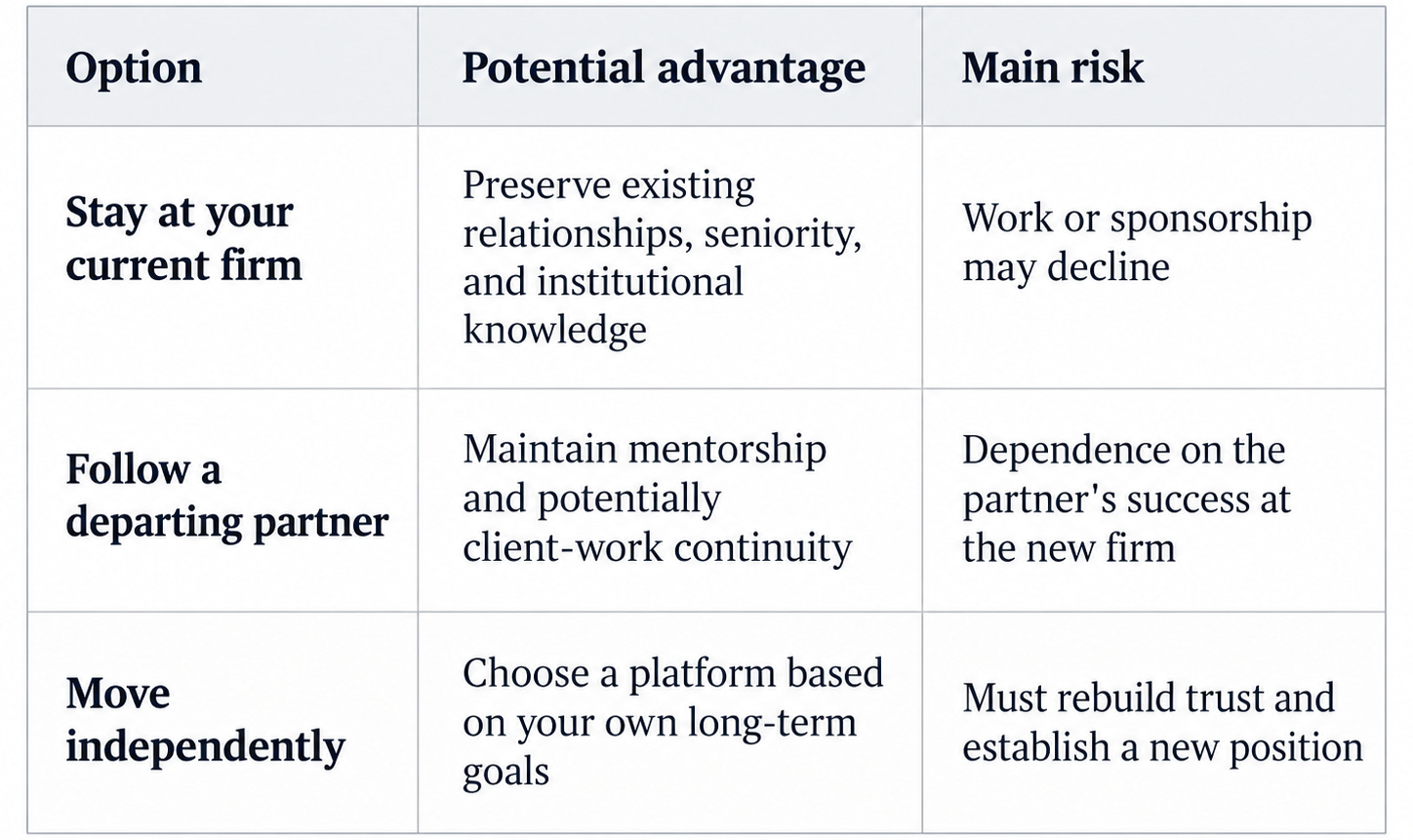
The best choice depends on the strength of your current position, the realistic opportunities at another firm, and your long-term career goals.
Step 6: Make Decisions Based on Evidence
Before resigning, understand the new firm’s actual offer, your likely assignments, compensation, and the applicable professional obligations.
A partner’s enthusiasm about a move is not the same as a confirmed associate position.
And speculation about a possible merger is not the same as an announced transaction.
Good career decisions require verified information, not anxiety.
What Law Firms Should Learn From Partner Departures
Law firms should also examine what partner departures reveal about their own organizations.
A firm that depends too heavily on a small number of rainmakers may face substantial risk if those lawyers leave.
The answer is not only higher partner compensation.
Firms also need to build deeper institutional relationships and invest in the lawyers who will sustain their practices.
That means:
Developing more lawyers capable of maintaining client relationships.
Creating stronger succession plans.
Giving associates exposure to multiple partners.
Building institutional client teams.
Investing in mentoring and training.
Communicating clearly during leadership transitions.
Integrating lateral partners effectively.
Developing future partners internally.
Rewarding collaboration as well as individual business generation.
Addressing retention problems before they become crises.
A prestigious law firm should be more than a collection of highly compensated individuals.
It should be an institution capable of delivering consistent value even when important people leave.
This is where the broader issue of partner compensation becomes relevant.
A law firm that pays aggressively for star partners but neglects associate development, institutional relationships, and succession planning may be investing in short-term revenue without building long-term stability.
The Discussion BigLaw Needs to Have
Partner departures create difficult questions for the legal profession.
Should associates follow partners who control their work?
Should associates prioritize firm prestige or personal mentorship?
Can a law firm be financially successful while offering uncertain career paths?
Are firms becoming too dependent on individual rainmakers?
Should partner compensation reward client ownership more than institutional contribution?
Does aggressive lateral hiring strengthen law firms or make them less stable?
Should law students evaluate partner turnover before choosing an employer?
And perhaps the most important question:
Does loyalty protect an attorney’s career, or does marketability provide better long-term security?
The answer is not the same for every lawyer.
Loyalty can create trust, sponsorship, and opportunity.
Marketability creates alternatives.
The strongest careers often require both.
The Final Lesson
BigLaw stability is becoming a more complicated question.
A famous firm name does not guarantee that a particular practice group will remain unchanged.
High profits do not guarantee that important partners will stay.
Strong compensation does not guarantee long-term career development.
And excellent performance does not guarantee that an associate’s work will remain available when client relationships shift.
Partner departures can create uncertainty.
But they can also create opportunity.
An associate may gain responsibility by staying.
Another may advance by following a trusted mentor.
A third may find a better platform through an independent lateral move.
The important thing is to understand the difference between reacting to instability and managing your career strategically.
Attorneys should build strong relationships.
They should develop marketable experience.
They should understand where their work originates.
They should pay attention to their firm’s direction.
And they should evaluate opportunities before they are forced to make decisions under pressure.
Because the real question is not simply whether a law firm is stable.
The more important question is whether your legal career can remain strong even when the people around you decide to leave.
That is the kind of stability every attorney should be building.
Unlock more opportunities to advance your legal career. LawCrossing helps attorneys explore a wide range of legal positions across different employers, including opportunities that may not be advertised on conventional job boards.
Expand your legal job search beyond publicly advertised openings. BCG Attorney Search connects attorneys with leading law firms and provides access to exclusive, confidential, and hard-to-find opportunities. Explore available positions that align with your experience, practice area, and long-term career goals.